

Estimated reading time: 3 minute(s)
An article in a local newspaper this week:

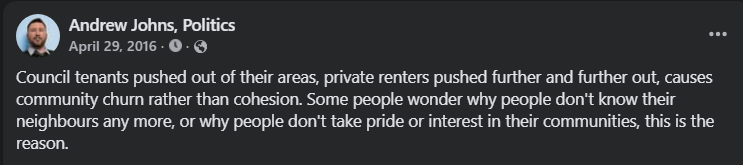
Being a resident of Walthamstow and London generally, a former social housing tenant as a child, and now part of generation rent, I’ve seen and been warning about the direction we were going in since 2016:
And when I stood as a candidate in the 2018 local elections, I wrote about how the cost of living, the lack of secure housing, and spiralling rents were already pushing people out of the area:
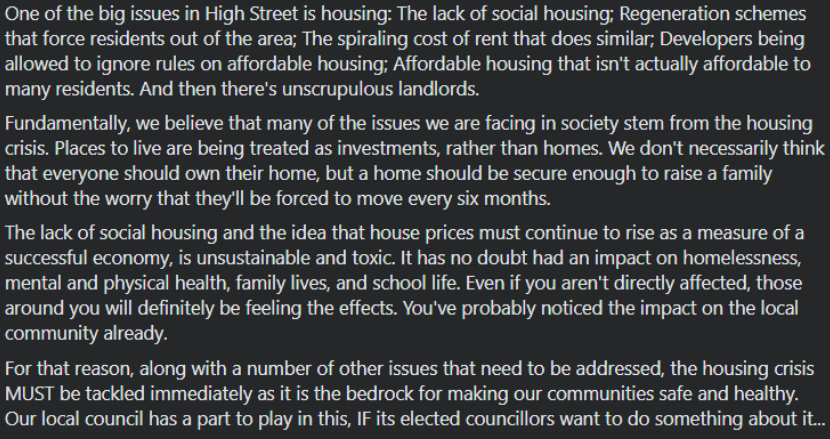
So it’s no surprise then that birth rates have fallen 20% since 2012, primary schools are closing, and families are being forced to move out of the communities they’ve lived in for generations.
What we are seeing now with falling birth rates and school closures is simply the next chapter in the same story. Housing insecurity, unaffordable childcare, stagnant wages, and gentrification are not isolated problems: they are interconnected parts of a wider system failure.
- If housing is unstable, families delay having children.
- If wages don’t cover the basics, parents are forced into longer commutes or out of the city entirely.
- If schools close because of falling rolls, communities lose one of their core anchors.
- If we lose families, we lose the very fabric of London’s future.
The wrong story vs the real story
Too often, when these shifts are discussed, people reach for the wrong explanation. They see schools with fewer white children, or census data showing ethnic change, and assume that’s the “problem.” The far right builds its entire story on this false premise.
But that’s a dangerous distraction.
What’s really driving the change is poverty and housing insecurity. Families with the money to leave do so. Families without the money are left behind. That dynamic maps onto race because of wider inequalities, but the root cause is economic, not ethnic.
When people are forced to move constantly, communities can’t integrate. Neighbours don’t know each other, kids don’t stay in the same school, and a sense of pride in place disappears. Stable, affordable housing is the foundation for cohesion. It’s how you build communities that thrive, no matter how diverse they are.
Where London went wrong
For too long, London has treated homes as investments rather than places to live, while failing to build enough truly affordable and social housing. We’ve tolerated a childcare system that costs families hundreds of pounds a week. We’ve allowed developers to build “affordable” housing that isn’t affordable to most Londoners. And we’ve let the cost of living spiral while insisting that workers on the lowest wages somehow absorb the pressure.
The consequences are now unavoidable:
- Falling birth rates.
- Closing schools.
- Disrupted communities.
- A capital that works for the wealthy, but nobody else.
Sometimes I feel like there’s a whole generation of politicians who’ve never played Sim City (or the more modern Cities: Skylines). If they had, they’d know you can’t just keep zoning luxury apartments and ignoring schools, transport, and services. You hollow your city out until it collapses.
And here’s the truth: even the wealthy won’t be insulated from this forever. When there aren’t enough teachers, carers, nurses, shop staff, delivery drivers, or cleaners able to live nearby, London grinds to a halt. When families can’t put down roots, whole communities become hollowed out, unsafe, and unstable.
What this means for London’s economy
When families can’t afford to stay, it’s not just schools that disappear, it’s the workforce that keeps London running. Who can actually afford to live and work here if rents keep spiralling?
- Not the minimum-wage worker staffing your supermarket, care home, or café.
- Not those stuck on zero-hours contracts or juggling multiple jobs.
- Not the single person forced into flatshares well into their 30s.
- Not the young adult still living with their parents because they can’t get a tenancy of their own.
The city becomes reliant on commuters travelling in from further and further away, which means longer journeys, higher travel costs, and more pressure on already stretched transport systems. Eventually, even that breaks down, because people decide the effort isn’t worth it.
An economy without families, without affordable workers, without people able to put down roots, is an economy in slow collapse. London risks becoming a city only for the wealthy and the transient, and that is not a sustainable model for jobs, services, or communities.
The solutions are clear
The solutions aren’t complicated, but they require political will:
- Rent controls and an end to no-fault evictions.
- A real living wage so people doing the lowest-paid but most essential jobs can afford to stay in the areas they serve.
- Investment in social housing and childcare as infrastructure, not optional extras.
- Sustainable communities where people don’t need to travel an hour to work or put their kids on a bus for half an hour just to reach school.
We’ve been raising these alarms for at least a decade. The birth rate collapse and school closures are not accidents. They are the predictable outcome of policies that prioritised short-term gain over long-term sustainability.
If London is to remain a city for all, not just for the wealthy, we need to change course now. Otherwise, we are pricing out families and London’s future.